
Argentina CBI Preparation Guide: Source of Funds, Documents & Due Diligence
In this guide: Why Argentina · What was announced · Tax · Source of funds & wealth · Preparation steps · How processing works · Legal status & history · Is CBI right for you · CBI vs naturalization · FAQ
Why Argentina?
Argentina is a G20 member state with a large economy, abundant natural resources, and diverse business opportunities offering access to the wider Latin American market. Argentine citizenship provides visa-free mobility to over 172 countries, as well as regional travel using only a national ID card (DNI) and the ability to obtain residency under regional agreements. With its neutral geopolitical position and rich, diverse culture, Argentina is an appealing option for internationally minded investors and families.
For investors considering Argentina’s citizenship-by-investment program, the benefits extend beyond obtaining a second citizenship. It provides a strategic pathway to expand business opportunities, strengthen regional connections, diversify long-term plans, and allow family members to put down roots in a country where they can live, work, and build their future.
Argentina Citizenship by Investment Without Prior Residency Requirement
Argentina’s citizenship-by-investment announcement has introduced new information for prospective applicants. This guide serves to explain the program update. If you are interested in an individual assessment and document preparation, see our Argentina Citizenship by Investment service.
On 2 October 2026, Argentina’s Ministry of Economy officially announced the Citizenship by Investment Program, designed so that a qualifying contribution or bond subscription can bypass the standard two-year residency period, a first for South America. Implementing rules are still pending, and applications are expected to open in the fourth quarter of 2026.
The recent legal reform, as outlined in DNU 366/2025 and Decreto 524/2025, has paved the way for foreign nationals to obtain Argentine citizenship through the Citizenship by Investment Agency (APCI). Note: The validity of DNU 366/2025 has been challenged in court (see “Development Progress History” below), so applicants should follow the final APCI regulations and any court developments.
The Ministry of Economy’s 2 October 2026 announcement set two routes: a non-refundable contribution of US$350,000 to the National Treasury, or the subscription of a US$800,000 public bond created for the program, plus additional contributions for family members (US$100,000 for a spouse or an unmarried child aged 18–25 without children; US$25,000 per child under 18). A seven-year, zero-interest structure for the bond has been reported but is not yet confirmed in final rules. All amounts and conditions remain subject to the implementing regulations; see the full details on our Argentina CBI Program page.
Argentina CBI: US$350,000 Non-Refundable Contribution Route
The US$350,000 route deserves particular attention due to its lowest investment threshold.
It is important to understand that this is a non-refundable contribution to the Argentine National Treasury.
It should therefore not be described as a conventional investment in real estate, a company, or another asset that the applicant expects to recover.
Applicants considering this route should evaluate the contribution as the principal financial requirement for the citizenship pathway, in addition to professional fees, due diligence expenses, translations, apostilles, government charges, and other applicable costs.
What this means for your documents: before any contribution is made, the funds must be traceable to a lawful source and are expected to move through the formal banking system. Preparing your source-of-funds file first avoids delays later. Full terms and the side-by-side comparison are on the Argentina CBI Program page.
Argentina CBI: US$800,000 Public Bond Option Explained Route
The second route involves a dedicated Argentine public bond with an announced subscription amount of US$800,000.
This route is potentially different from the contribution option because the applicant’s capital is associated with a government security rather than a non-refundable Treasury contribution.
However, investors should not make a decision based only on the headline amount.
Before subscribing, applicants should review the final terms covering:
- Maturity
- Redemption
- Interest
- Transferability
- Custody
- Currency
- Payment mechanics
- Treatment if an application is refused
- Treatment upon early exit
- Any applicable restrictions
The supplied program materials describe the expected bond as a seven-year, zero-interest instrument, but the final government rules should be treated as controlling once published.
What this means for your documents: bond subscription funds face the same source-of-funds and traceability review as a contribution. Final custody and payment mechanics are not yet defined, so keep records showing how the capital was accumulated and where it is held. Compare both routes on the Argentina CBI Program page.
No Worldwide Tax for Investment by Naturalized Argentine Citizens
Foreigners who obtain Argentine citizenship through the investment/contribution (CBI) route are not automatically subject to worldwide taxation. Their foreign-source income remains untaxed unless they become tax residents of Argentina, as confirmed by Article 194 of the law passed by Congress and Article 116 of the reformed Income Tax Law.
How to Start Preparation for Argentine Citizenship By Investment
Although Argentina’s CBI program is still in the development stage, with applications expected to open in the fourth quarter of 2026, you can begin your Argentina Investment Program preparation, as the initial intake of the Argentine Citizenship by Investment (CBI) program has been reported as limited to around 5,000 applicants, a figure not yet officially confirmed. Caps for each country/nationality may also be imposed, so citizens of competitive countries are recommended to stay ahead.
Due to this potential applicant cap, Immi Legal proudly offers an Investment Preparation Program Package, as early preparation of documents is crucial to streamline the process in this competitive applicant pool. This helps you get ahead by preparing your documentation and application strategy before the program officially opens. Don’t wait until it launches to gather documents, contact us to start your preparation toward Argentine citizenship!
Begin with an assessment of your family circumstances, funding history and available supporting records. Prepare a document inventory before ordering time-sensitive certificates or translations. Our team can identify gaps and explain the scope of preparatory assistance. Formal filing arrangements will be explained when the applicable procedures and submission channel are confirmed.
Early preparation reduces avoidable delays; it does not guarantee a place or priority in any intake. A personalized document checklist is prepared after assessment.
Argentine Citizenship by Investment Preparation & Steps
1. Prepare Documentation
– Apostille or legalise all documents, such as your passport, birth certificates, marriage certificates (if applicable), criminal background checks, and proof of the legitimacy of the origin of funds (deeds, contracts, financial statements, and corporate acts) for due diligence and AML/KYC requirements.
– Ensure all documents are translated into Spanish locally and meet legalization/apostille standards.
2. Arrive and Establish Residency (Optional)
– Apply for a temporary residence permit upon arrival (rentista/pensionado, employment, family, digital nomad), then apply for CBI within Argentina. This is the ordinary residence-based route. Residence in Argentina is not expected to be a requirement for the CBI route.
3. Submit Your CBI Application
– Submit your application and investment proof through the channel confirmed by APCI; fingerprints and biometric data are expected at the approval stage (see above).
– The DNM is expected to issue a decision within 30 days after receiving APCI’s recommendation. The overall process, including review and passport issuance, typically may take 4-6 months, depending on the complexity of the case and subject to the workload at the time of submission. Preparation time and the government’s processing period are different stages. A complete end-to-end timetable, including any travel and document issuance steps, should be confirmed against the applicable program procedures. IMMI Legal does not promise a fixed approval or passport delivery date.
4. Wait for the Citizenship Approval
– Once official citizenship is approved by Migraciones, attend Renaper to obtain the Argentine National Identity Document (DNI) for the new citizen and register with AFIP/ARCA for tax and social security ID.
5. Obtain Your Argentine Passport
– After receiving your citizenship certificate and DNI, request your passport.
– Expedited same-day instant passport issuance is doable at the airport after the DNI is in your hands.
That’s it. Once you reach this stage, congratulations, you are an Argentinian. The steps above are indicative and subject to the final APCI rules; your personalized roadmap and timeline can be provided after assessment.
Source of Funds and Source of Wealth for Argentina CBI
Source-of-funds (SOF) and source-of-wealth (SOW) review is expected to be one of the most closely examined parts of any Argentina CBI file. The sections below explain the principles at a high level; your personalised checklist is prepared after assessment.
What “lawful source of funds” means
Lawful source of funds means being able to show, with independent documents, the legitimate activity that generated the money you intend to use (for example, employment income, a business, the sale of an asset, an inheritance or investment returns) and that it was earned and taxed lawfully.
Traceability of funds
Traceability is the paper trail connecting that original source to the account the contribution or bond payment will come from. Reviewers look for a continuous, documented path, with each transfer explained and each account identified, rather than a single statement showing a balance.
Why a bank statement showing the balance is not enough
A balance only shows that money exists today. Due diligence asks how it got there, so a statement is normally supported by documents that explain the source (such as contracts, tax filings or sale agreements) and the movement of the funds.
Documenting common sources of wealth
- Employment or professional income: employment records, payslips, tax returns and the bank statements where the income was received.
- Business ownership and company funds: corporate records, financial statements and evidence of dividends or distributions showing your entitlement to the money.
- Sale of a business or property: the sale agreement, proof of ownership, evidence of the buyer’s payment and where the proceeds were deposited.
- Inheritance: probate or will documents, proof of the family relationship and evidence of the transfer of the assets.
- Stocks, bonds and other investments: account statements over time and records of purchases, sales and returns.
- Funds held abroad: statements from the foreign institution and evidence the money was lawfully earned, with any required apostille or sworn translation.
Assets in several countries, higher-risk jurisdictions, and PEPs
Assets in several countries make the file longer rather than impossible: every account and entity should appear in one clear wealth narrative. Ties to higher-risk jurisdictions, or status as a Politically Exposed Person (PEP), can trigger enhanced due diligence, so these facts should be identified early and documented carefully.
What commonly goes wrong in a source-of-funds review?
Typical problems include unexplained large deposits, gaps or mismatches between documents, undocumented family gifts, funds that passed through third-party accounts, and documents that were not apostilled or translated. Finding these early is far easier than correcting them after submission.
Because every file is different, a personalised checklist is prepared after assessment. See how we help on our CBI Argentina preparation service page.
How CBI Processing Works
Official due diligence is expected to be carried out by AML/KYC firms with global CBI experience, under the oversight of the Agency for Citizenship by Investment Programs (APCI), for further submission to APCI as part of its review of the application.
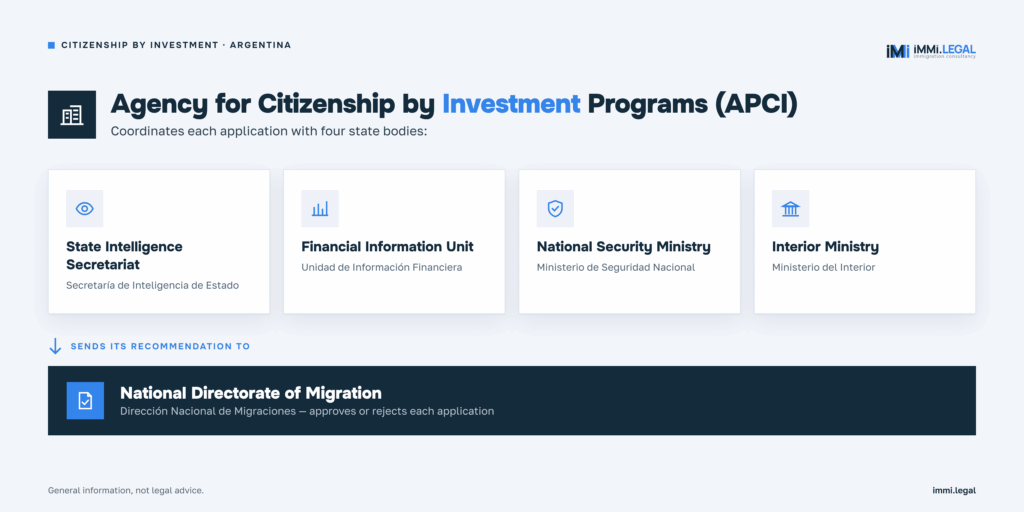
APCI coordinates the review of each application in collaboration with the State Intelligence Secretariat, the Financial Information Unit, the Ministry of Security, and the Ministry of the Interior.
Once its assessment is complete, the APCI sends its recommendation to the National Directorate of Migration (Migraciones), which is the final authority to approve or reject the application within 30 days.
The review process typically includes checks on:
- Identity
- Lawful origin of the funds
- Criminal and reputational records
- Jurisdictional risk
- Immigration history
Argentine Citizenship by Investment Development Progress History
The current administration is developing South America’s first citizenship-by-investment program, to be administered by a newly established agency (Agencia De Programas De Ciudadanía Por Inversión) under the Ministry of Economy, ensuring strong legal backing, alignment with national economic goals, and robust security controls. The government has launched an international public tender to select experienced global firms for the program’s design, implementation, and promotion, aiming to attract over USD 2.5 billion in foreign investment. According to the official bidding evaluation report reflected in the Argentina CBI Tender Results, the process is being conducted under a formal legal framework and has drawn participation from leading international firms progressing to the technical and economic evaluation stage with top-ranked bidders. This might potentially signal that Argentina is moving toward selecting a professional operator and positioning itself as a credible and competitive destination for investment-based citizenship in the world. However, pursuant to Resolution RESOL-2026-522-APN-MEC dated April 14, 2026, the tender process was subsequently canceled.
Nonetheless, on April 27, 2026, under Decree No. 285/2026, the government advanced the institutional development of the program by appointing, effective April 22, 2026, Ms. Aixa Granara as Executive Director of the Agency for Citizenship by Investment Programs (APCI), a decentralized body operating within the Ministry of Economy, on an ad honorem basis, signaling continued commitment to the development of the CBI program despite the cancellation of the tender process.
The National Electoral Chamber’s decision annulling DNU No. 366/2025 as unconstitutional, along with subsequent Federal Civil and Commercial Appeals Court decisions in citizenship cases has raised serious questions regarding the legal validity of DNU No. 366/2025, particularly its transfer of citizenship adjudication authority from the federal courts to the National Directorate of Migration (DNM).
Despite the National Electoral Chamber’s ruling annulling Milei’s citizenship and migration decree as unconstitutional, and despite bills filed by the opposition to prohibit the sale of Argentine citizenship, Economy Minister Luis Caputo and Chief of Cabinet Diego Santilli have announced that the Citizenship by Investment program will launch in the last quarter of 2026.
Latest (2 October 2026): Economy Minister Luis Caputo and Chief of Cabinet Diego Santilli presented the program’s terms in Paris during Argentina Week (a US$350,000 contribution or a US$800,000 bond, with family contributions) and stated that applications are expected to open in Q4 2026. At the time of the announcement, the implementing regulations had not yet been published in the Boletín Oficial. The program’s legal basis (DNU 366/2025) remains subject to the court rulings described above.
Is Argentina Citizenship by Investment Right for You?
The new CBI Argentina program may be particularly relevant to:
- High-net-worth individuals seeking a second citizenship
- International entrepreneurs
- Global investors
- Business owners
- International families
- Individuals seeking greater mobility and international optionality
- Investors interested in establishing a stronger connection with South America
- Applicants who prefer a citizenship route that does not begin with years of physical residence
However, citizenship by investment is not simply a passport-purchase transaction.
Applicants should consider their objectives, family structure, financial profile, source of wealth, banking arrangements, tax position and long-term plans before selecting an investment route.
For some applicants, Argentina residency by investment or another Argentine residence category may be more appropriate than the CBI route. The right strategy depends on the individual’s objectives and circumstances.
See our pages on Argentina residency by investment and the Rentista visa for residence-based alternatives.
Can I Switch From Argentine Temporary Residency to Citizenship by Investment?
Another great option is to obtain Argentine residency, an Argentine social security number (CUIT/CUIL), open an Argentine local bank account, and prepare other documents for the Citizenship by Investment program. This way, if there are any delays in the launch of Argentina’s CBI, you can still apply for citizenship through naturalization after two years of continuous legal residence.
CBI Argentina vs. 2-Year Naturalization
The principal difference can be summarized as follows:
| CBI Argentina | Traditional Naturalization |
| Dedicated investment-based route | Residence-based route |
| Designed for qualified investors | Available under ordinary citizenship rules |
| Announced minimum contribution of US$350,000 | No CBI contribution required |
| US$800,000 public-bond alternative announced | Not applicable |
| Designed to avoid the ordinary two-year residence requirement; one in-country visit is expected at the approval stage (biometrics) | Two years of continuous legal residence required |
| Rigorous financial and security due diligence | Ordinary citizenship requirements |
| Q4 2026 application launch announced | Existing pathway |
The two routes should not be treated as interchangeable. An applicant who does not need an investment-based citizenship route may have other Argentine immigration and naturalization options.
Conclusion
Relocation to Argentina gives access to a country rich in resources and possibilities, guiding significant investments in various key sectors. The application process demands attention to detail and highlights the importance of financial legitimacy and potential economic impact, as well as accurate translations.
Whether you are looking for temporary residency, permanent relocation, or considering CBI Argentina as a strategic pathway, Immi Legal can guide you through every step of the process. Our commitment to professionalism and transparency will help you transition smoothly into Argentina’s vibrant business ecosystem. Contact us today to book an onboarding consultation for investment-based citizenship and business opportunities in Argentina.
Citizenship by investment is not a passport purchase: the quality of strategy, document preparation, timing and case management shapes the outcome. IMMI Legal’s role is to assess your situation, prepare your file and keep your case managed from start to finish, with legal questions handled by licensed Argentine lawyers.
FAQ
CBI Argentina refers to Argentina’s new Citizenship by Investment Program, under which eligible foreign nationals may obtain Argentine citizenship through a qualifying investment or contribution without first following the standard residence-based naturalization route.
The announcement positions the program as part of Argentina’s broader strategy to attract international capital and strengthen the country’s integration with global investment markets.
Unlike conventional Argentine citizenship by naturalization—which requires a two-year residency—the primary attraction of Argentina’s Citizenship by Investment program is the ability to pursue citizenship directly through the dedicated investment framework, bypassing the ordinary two-year residence period.
No. The announced framework is designed to bypass the usual two-year residency requirement, with one in-country visit expected at the approval stage for biometrics. Final rules will confirm the details.
Yes. Expect source-of-funds and source-of-wealth due diligence on every application. Showing where your money came from is a core part of the due diligence review to see a clear picture of how your wealth was built and a paper trail they can follow. They may also look at your business activities, tax filings, and asset ownership. The goal is simple: the funds must meet standard anti-money laundering and counter-terrorist financing rules.
Legitimacy of the origin of the source of funds means you can explain how you earned or received the money and back it up with documents. Common sources include running a business, selling a company or shares, dividends, an inheritance, a property sale, or investment gains. The paperwork depends on your circumstances. A business owner usually needs company accounts and dividend records, while an heir needs the will, probate papers, and proof that the assets were transferred.
A good first step is to obtain a Certification of Origin of Funds letter, based on a Report of Factual Findings prepared by an independent Certified Public Accountant.
Obviously not, because a bank statement proves that the money is there, not where it came from. A balance of USD 500,000 could come from business profits, a property sale, or an inheritance, and reviewers need to know which. Typical extra documents include:
- Business sale: the signed sale agreement, proof of ownership, and evidence that the proceeds arrived.
- Company dividends: financial statements, dividend resolutions, tax filings, and payment confirmations.
- Inheritance: the will or probate papers, distribution records, and bank statements showing that you received the funds.
It’s the ability to follow your money from where it started to the account you’ll use for the investment. If a property sale paid straight into your personal account, the trail is short. If the money passed through several companies, brokerage accounts, or banks in different countries, each step needs a document linking it to the next.
Moving money across borders is not a problem in itself. What matters is explaining why each transfer happened, who owned the funds at each stage, and how it all connects back to the original source.
It depends on how your wealth was created and where it’s held. Commonly useful records include:
- Personal and corporate bank statements
- Personal and corporate tax returns
- Company registration papers and shareholder registers
- Share purchase agreements or company sale contracts
- Dividend declarations and proof of payment
- Property purchase and sale agreements, title deeds and closing statements
- Audited financial statements
- Brokerage statements and liquidation records
- Wills, probate documents and inheritance records
- Loan agreements with proof of disbursement
- Contracts and invoices for major business or consulting work
- International wire confirmations (SWIFT messages where available)
- Trust deeds and beneficiary distribution records
A clear, well-organized file that tells a consistent story, supported by a CPA letter, is extremely helpful.
Yes. Your funds don’t have to come from the country of origin, as long as you can document who owns them, where they came from, and how they moved. You may need to show the country and bank, statements proving you’re the account holder or beneficial owner, how the money first entered the account, and transfer records linking it to any other accounts involved. If the money passed through several countries, expect to provide records from each.
Yes, when you can clearly evidence both the sale and the receipt of the money. Useful documents include:
- The signed share or asset purchase agreement
- A company registry extract showing you owned the business before the sale
- Financial statements showing the business history
- Bank statements showing the proceeds arriving
- Relevant tax filings
- Escrow or settlement records, if applicable
If the money was later moved or reinvested, those steps need documenting too.
To prove assets inherited from a deceased person, you usually need a death certificate, the will or probate court documents, proof that you are the heir, the estate inventory and distribution records, and bank statements showing that you received the money. If you inherited property or investments and converted them into cash, include records explaining that conversion.
If the inheritance came from another country, the documents may need an apostille (or equivalent legalization) and a certified Spanish translation.
This is very common for entrepreneurs, but company money is not automatically your personal money, even if you own 50% of the shares. You will need to show that you are a shareholder of the company and that there is a lawful basis for moving the funds into your name. Typical support includes:
- Company registration and current corporate records
- Shareholder registers or other proof of beneficial ownership
- Financial statements and accounting records
- Board resolutions, where required
- Dividend declarations or shareholder loan agreements
- Bank records of the transfer to your personal account
- Relevant tax filings
If your company sits inside a group of holding entities, the ownership at each level needs to be documented. Before moving company funds for a personal investment, make sure the transfer is legal and tax-compliant in the relevant countries.
Your broker, bank or fund manager can supply most of what’s needed. The records should show how you funded the original investment, how it grew, and how it was converted into the cash you plan to use. Helpful documents include:
- Brokerage account statements
- Purchase and sale confirmations
- Portfolio valuation reports
- Dividend or interest statements
- Fund redemption or liquidation confirmations
- Bank statements showing the proceeds arriving
- Tax records on investment income or capital gains
Aim for a clear narrative of your investment history, not thousands of lines of trading data.
Not necessarily. Many international investors have accounts, companies and property in more than one country. The real challenge is making sure documents from different places fit together. It helps to map out:
- Which documents you already have in each country
- Which records you still need to request from banks or registries
- Which documents need an apostille or legalization
- Which need certified Spanish translations
- How ownership and fund movements connect across accounts and entities
Double-check names, dates, ID numbers, and company details. Even small spelling differences or outdated corporate information can trigger extra questions.
The countries where you live, bank or do business can be part of the review, as can your professional background, public profile, and political connections. Having an account or business in a higher-scrutiny country doesn’t automatically mean a rejection. It may just mean more questions. PEPs and people with complex profiles typically face enhanced due diligence under standard compliance rules.
Clear records explaining your activities, ownership structures, and transactions work far better than trying to simplify or leave out parts of your history.
Problems usually come from documents that don’t tell a consistent story or leave transactions unexplained. Watch out for:
- Transfers between accounts with no explanation
- Money from a company without proof you own it or are entitled to it
- Large transactions with no contract or clear business reason
- Gaps between declared income, tax records and bank activity
- Inconsistent names, ID numbers or company details
- Missing historical bank statements
- Third-party payments with no contractual or legal basis
- Ownership structures that are hard to verify
- Foreign-language documents without translations
- Big changes to asset ownership shortly before applying, with no paperwork
Most of these have perfectly legitimate explanations. The trick is to spot them early and gather the evidence before your file goes in for review.
Argentina CBI – Due Diligence-related FAQ
Due diligence for the Argentina Citizenship by Investment program is expected to be rigorous. It is designed to protect national security, the integrity of the financial system, and the international standing of Argentine citizens, and it is expected to follow OECD and FATF recommendations. These standards are generally more thorough than the checks historically used in some Caribbean and European programs. Applicants should expect a full background review covering identity, criminal and regulatory record, and media profile. Above all, they should expect a review of the lawful origin of the funds to be invested: every source of wealth should be traceable and supported by independent evidence. Any potential red flag should be identified, explained, and documented before the application is submitted, not after.
Screening databases match on names, so a common name can return many possible matches (“false positives”) that have nothing to do with the applicant. This is frequent with very common surnames, with names transliterated in several ways from Chinese, Arabic, Cyrillic, or other scripts, and with applicants who share a name with a well-known political figure from a country of origin.
A possible match is not a finding against you. It has to be resolved by comparing details such as date of birth, place of birth, parents’ names, nationality, and photographs. The match is then either ruled out or confirmed and assessed on its merits.
If a record is wrongly attributed to you, the usual response is to document the difference: official identity documents, the parents’ names shown on the birth certificate, and a sworn statement explaining why the person in the record is not the applicant. In some cases a second independent check is commissioned, and both results are kept on file.
To reduce the risk, give your adviser every name and spelling you have used, including those in other alphabets and in older documents, and make sure the spelling is consistent across your passports, civil documents, and bank records.
A change of name is common and is not a problem when it is documented. Reviewers need to be able to link every name you have used to you as one person. Typically this means:
- The official document recording the change, such as a court order, marriage certificate, or equivalent
- An apostille or legalization and a certified Spanish translation of that document
- Evidence that the current name is used consistently in your passport and other records
If your birth certificate was issued years after your birth or reconstructed because civil registration was not yet in place at the time, explain this in a short sworn statement and support it with whatever official evidence exists, such as the registry record, older identity documents, or school records. A documented explanation is far better than an unexplained difference.
The same applies to a university, employer, or company that has been renamed. A short statement showing that it is the same institution avoids avoidable questions.
Pre-screening due diligence is a preliminary check carried out by the applicant’s adviser before an application is prepared or submitted. The official due diligence is the formal review expected to be conducted under the authority of the Argentine government as part of the application.
Pre-screening can be done at different levels of depth, depending on how much comfort the applicant wants:
- Basic database screening: the applicant’s name, country, and date of birth are checked against sanctions lists, Politically Exposed Persons (PEP) lists, enforcement records, and adverse media databases. It finds obvious red flags, but it is not a research exercise.
- Enhanced screening: the same check, plus manual resolution of possible name matches and media searches in the applicant’s own language, for example, Chinese, Russian, or Arabic.
- In-depth background report: investigators research the applicant’s profile, business connections, and public record in more depth and can review the documents supplied.
Three points are worth keeping in mind:
- Pre-screening helps you find and fix problems early. It does not confirm eligibility or guarantee approval.
- A clean pre-screening result is not the same as a clean official review. The official due diligence is wider in scope and is controlled by the authorities.
The purpose of pre-screening is to identify any issues before a formal submission and before significant costs are committed. If anything surfaces, the assessment looks at:
- Its nature and seriousness, and whether it involves allegations of financial crime
- How long ago it occurred and whether it has been fully resolved
- Whether supporting documents are available, such as court judgments, settlement agreements or legal opinions
Minor or historical commercial matters that have been resolved are usually manageable. They are typically addressed through a clear explanatory statement supported by documentary evidence. They may lead to additional questions and some delay, but do not necessarily affect the outcome. The most important principle is full and accurate disclosure: issues that are disclosed and explained are generally far less damaging than issues the reviewer discovers independently, as non-disclosure can itself be grounds for refusal.
If something does surface, the realistic outcomes are:
- It is minor or resolved: we prepare an explanatory statement with supporting evidence and continue.
- It is a documentation gap: we identify what is missing, for example, a bank letter or a registry extract, so that it can be obtained before submission.
- It is a name match or an error: we document the difference and, where appropriate, obtain a second independent check.
- It is serious or unresolved, especially if it involves financial crime: we will advise you honestly that submitting may not be advisable. An applicant who chooses to proceed despite that advice should understand that professional and government fees may not be recoverable if the application is refused, depending on the final rules.
Note: The exact approach will vary by the due diligence provider appointed by the government. The above reflects standard industry practice rather than a fixed rule for any one application. The final decision always rests with the relevant government authority.
Want to know how your own profile looks before the program opens? Our team can review your source of wealth, flag possible red flags, and prepare an explanation for them before any formal submission. See our CBI Argentina preparation service page or contact us to get started.
Screening typically combines:
- Commercial risk and compliance databases
- International sanctions lists (UN, OFAC (US), EU, and UK) and Politically Exposed Persons (PEP) lists
- Law enforcement sources, including Interpol notices
- Open-source media and internet searches in both English and the applicant’s native language (for Chinese nationals, this includes Chinese-language news, court judgment databases, corporate registry records, and enforcement or credit blacklists)
- Document and background verification, such as confirming employment and education history with the employer or institution concerned
- Local inquiries through private investigators in the applicant’s country of origin, who can find information that is not available online
A minor matter does not automatically rule out an application, but it must be disclosed and understood. What matters is the nature of the matter, how long ago it happened, how it was resolved, and whether it involves financial dishonesty.
- A minor administrative or traffic-related penalty is generally far less serious than anything involving fraud, money laundering, tax or other financial offenses.
- A penalty abroad should be compared with how the same conduct is treated in Argentina. A fine that would also be a fine in Argentina is very different from conduct that Argentine law treats as a serious crime. This comparison can be made by a licensed Argentine lawyer.
- Matters connected with financial crime are the most difficult, whatever their age, and can mean that submitting an application is not advisable.
Tell your adviser about everything, including matters you consider trivial. We need the official record, the final decision or proof of payment, and a short written explanation. We cannot assess a matter we have not been told about, and a reviewer who finds it independently will treat it more seriously.
The definition is broader than criminal records and sanctions. Reviewers will usually note:
- Criminal investigations, charges, or convictions
- Sanctions, PEP status, and regulatory enforcement actions
- Allegations of fraud, corruption, money laundering, or tax evasion
- Administrative penalties
- Commercial and civil litigation, bankruptcy, or court enforcement orders
- Negative press coverage
A finding is not automatically disqualifying. Each item is assessed on its nature, severity, how recent it is, how credible the source is, how it was resolved, and whether it relates to financial crime. A settled commercial dispute is treated very differently from an open fraud allegation.
There is not typically a set cutoff for media searches. As a rule, the older the matter, the less weight it carries, but serious issues like financial crime are relevant regardless of their age. Police clearance certificates are generally required from each country where the applicant has lived for any length of time, often for the past 10 years.
Plan to document more than the account your money is in today. The reviewer’s question is how your wealth began and how it grew, not only where it sits now. Applicants are often asked to explain the first meaningful source of capital, even when the current funds are held in a well-known bank or brokerage account.
A practical way to prepare is a short wealth narrative, often condensed to about two pages. It summarizes your education, employment, and business history; major transactions; how assets moved between countries and entities, and where the funds are held now. Each statement is supported by a document in your file. Having it ready makes it easier to answer questions quickly and to spot gaps before a reviewer does. The narrative must be accurate and consistent with your documents: it describes what happened; it does not reshape it.
For example, if your funds are in a brokerage account in one country but the shares were first acquired elsewhere and transferred over time, the file should explain each step: how the original shares were acquired, why and when they moved, and how the proceeds reached the account you will use.
Wealth from cryptocurrency trading, mining or Web3 businesses is not a bar in itself, but it generally attracts enhanced due diligence, because the reviewer must be able to trace the funds clearly from their origin to the point of investment. The most common problem is not the crypto itself but crypto that was left out of the file. Declare every exchange, wallet and account you have used and explain how the activity was funded and taxed.
Documentation typically requested includes:
- Statements and full transaction histories from the exchanges used, ideally regulated, KYC-verified accounts
- Evidence of the original fiat funds used to acquire the assets (for example, bank transfers to the exchange)
- Wallet addresses, which may be reviewed using blockchain analytics tools
- Records showing conversion to fiat through a regulated exchange or OTC desk, with the proceeds received into a bank account in the applicant’s name
- Tax filings declaring the relevant gains or income, where applicable
- For mining: equipment purchase invoices, hosting or electricity contracts and mining pool payout records
- For Web3 businesses: company registration documents, financial statements, shareholding records and any licences held
- A clear explanation of how the crypto activity fits into your overall wealth history, for example, alongside salary, dividends, or property
Reviewers will also consider the jurisdictions where the activity took place and how funds were transferred across borders. Where activity occurred in a jurisdiction with crypto restrictions or capital controls, this should be explained clearly and documented carefully. In practice, investment funds will also need to be in fiat currency and remitted through the banking system.
Not by itself, but the reviewer will ask whether the declared source can reasonably explain the amount. Wealth built from employment is common, particularly in technology and finance, and is fully acceptable when it is documented. Where the amount is large relative to the salary, expect to be asked to bridge the gap with evidence such as:
- Employment contracts and payslips for the relevant years
- Bonus, share-option or equity-compensation records, and records of the sale of those shares or options
- Personal tax returns showing the income and any gains
- Records of investments made from that income and how they grew
- Bank statements showing savings building up over time
If the explanation for how the amount was reached is incomplete, reviewers may conclude that something has not been disclosed. A short written explanation, with a document behind each step, is the most effective way to answer that question before it is asked.
Related Articles