Argentina Citizenship By Investment 2026

Dreaming of living in a country with European charm, affordable living, and high investment potential? Argentina Citizenship by Investment (CBI Argentina) is attracting global entrepreneurs, retirees, and investors. Whether you’re looking for a second passport, visa-free travel, or business opportunities in Latin America, Argentina offers one of the fastest and most accessible investment migration paths in the world.

Recent legal reforms, as outlined in Decree 366/2025, have enabled foreign nationals to obtain Argentine citizenship through substantial, government-approved investments, without requiring an extended physical presence in the country.

 How can you obtain Argentine citizenship through investment, and start investing in the country’s growing economy? We simplify the process so you can confidently move forward with your Argentina Investment Program preparation simultaneously, while the project itself is still under development stage. Contact us to start your journey toward Argentine residency!

Argentina CBI Directly Supported by the Government – Under the Ministry of Economy

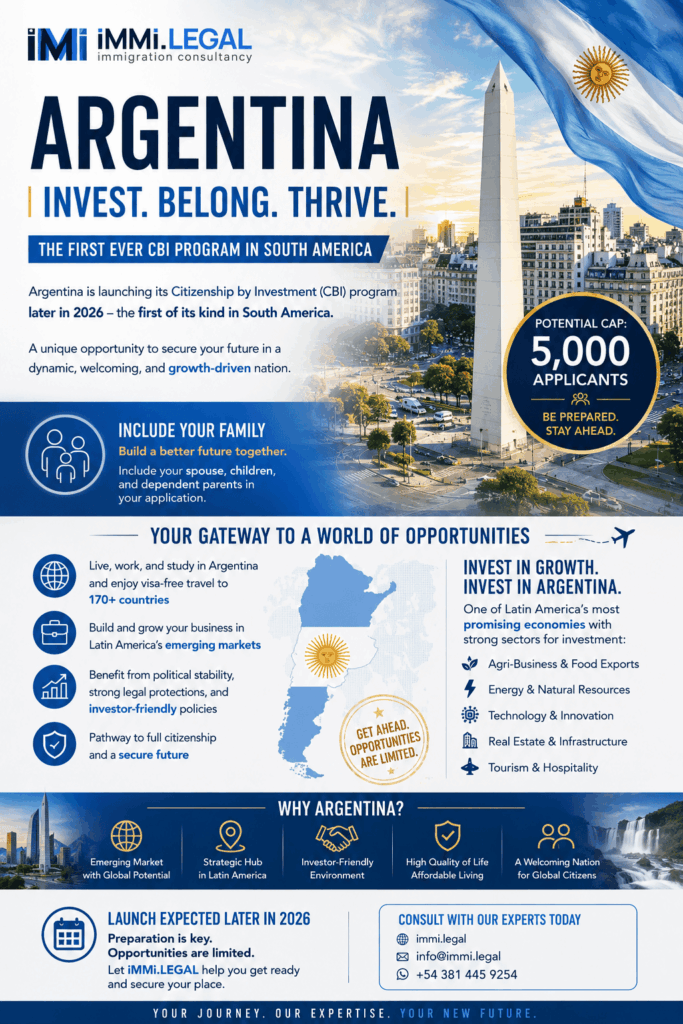
Argentina is developing South America’s first Citizenship by Investment program. It will be run by a new Citizenship by Investment Agency under the Ministry of Economy. This gives the program strong legal support, connects it to national economic goals, ensures proper security checks, and shows long-term stability. The Argentine government has launched a bidding process inviting experienced international firms to implement its new Citizenship by Investment program, aiming to attract over USD 2.5 billion in foreign capital. By linking investment and citizenship to the country’s economy, Argentina aims to attract foreign capital and become a trusted choice for investors seeking citizenship.

Argentine Citizenship by Investment: No Residency Required

As explained in official government announcements, Decree 366/25 amended Citizenship Law 346 to allow foreigners who have made a significant investment in the country to obtain Argentine citizenship, regardless of the minimum residence requirement.  A government Agency for Citizenship by Investment will review the applications, verify whether the investment qualifies, and consult with other Government departments, such as security, immigration, and tax authorities, to ensure there are no risks. If everything is approved, your application goes to the National Directorate of Migration, which will decide whether to grant Argentine citizenship. This new law is designed to make the Citizenship process faster for investors and help create jobs in the country.

How to Prepare Before Investment Applications Open

You have two options at this stage: 
The first is to legally reside in Argentina under regular temporary residency categories, and to legalize yourself with local documents, such as a social security number, DNI, bank account, etc.  

The second option, wait until the investment program officially starts accepting applications, which allows you to start the citizenship process immediately, even while living abroad.  Let’s explore each option in more detail below.

Option 1: Argentine citizenship by Naturalization

Foreigners can apply for Argentine citizenship by Naturalization after two full years of continuous residence with a DNI (ID Card)(365 days each year), without any single exit from the country during the two years.

For regular residency, short trips are allowed, but for citizenship, any exit resets the two-year count if you exit. We are going to discuss residency details a little later below. 

Option 2: Direct Citizenship by USD 500,000 Investment

The government announced that the initial citizenship-by-investment intake will be limited to 5,000 applications, which may be filled very quickly, considering the global interest in the program. The challenge is that no one yet knows which types of investments will be accepted,  whether real estate, government bonds, or active businesses. However, dactyloscopic biometric data and a photograph will certainly be required. If you are from a visa-required country, your chances of being among the first applicants may be comparatively lower than those of nationals from the USA, Europe, or other visa-free countries, because you will need a visa to cross Argentine borders legally. At some consulates, the nearest available appointments may take several months. For this reason, you may consider obtaining residency first, getting a social security number after arrival, and establishing a genuine presence in Argentina to experience the country where you plan to obtain nationality.

Government Launches 30-Year Investment Incentive Program for Large Scale Investors

Argentina offers a specialized program for ultra-high-net-worth individuals called the Large Investment Incentive Scheme (RIGI). Designed for foreign investments of USD 200 million or more, RIGI provides 30 years of legal and tax stability, making it one of the most attractive long-term investment programs in Argentina. Under RIGI, any newly introduced taxes or increases in existing taxes do not apply to qualifying projects, offering unmatched protection and certainty at the government level.

This incentive program supports strategic sectors including energy, mining, infrastructure, technology, and tourism, and is managed by the Ministry of Economy, in coordination with an interagency evaluation committee. Participating provinces, such as Río Negro, Chubut, Mendoza, San Juan, Salta, and Córdoba, can offer additional local benefits to approved projects. Applications are reviewed and approved within 45 days, and the program encourages local supplier participation. RIGI is ideal for international investors seeking stable, large-scale investment opportunities in Argentina with potential eligibility for residency or citizenship by investment pathways.

Employment Residency By Company Incorporation

Company formation in Argentina not only provides applicants with the opportunity to enjoy the richness of Argentine culture but also substantially boosts the country’s economy. You can become an active player in job creation, fostering the development of local services and production. For example, Argentina is currently one of the top countries in IT startups (Unicorns). By being committed to doing business in Argentina, you will significantly contribute to tax payments, strengthening fiscal resources, and supporting the provision of public services. This active involvement in the Argentinian economy not only paves the way towards Argentine citizenship but may also facilitate flexibility in terms of entry and exit for the applicants and flexible travel to Argentina, allowing seamless integration into the Argentine community while maintaining international connections. Thus, it solidifies a mutually beneficial relationship for both you and the nation. This pathway may also benefit individuals who frequently require a business visa or travel authorization to Argentina, as it creates a smoother and more permanent legal status.

Once the new Argentina Citizenship by Investment (CBI) program begins, you will be able to convert your temporary residency into immediate citizenship through investment, making it an ideal option for global investors seeking flexibility without full-time relocation.

Why Now Is the Best Time to Invest in Argentina

Argentina Citizenship By Investment is becoming one of the most attractive opportunities for global investors. In the third quarter of 2024 alone, Argentina received USD 2.4 billion in foreign direct investment, mainly in key sectors like banking, mining, and manufacturing. Top investors came from Spain, Brazil, and the U.S., reflecting strong international confidence. With the new Argentine Citizenship by Investment law and a 30-year tax benefit program for large-scale projects, Argentina is making it easier than ever to invest and build long-term opportunities. Whether you’re interested in real estate, starting a business, or entering export markets, Argentina Citizenship By Investment offers a direct path to Argentine citizenship. Now is the perfect time to make the first steps in Argentina’s growing economy and secure your future in South America.

Do I Need to Be in Argentina to Start a Company?

To incorporate a company in Argentina, investors must establish a legal entity, register for taxation, and comply with local business regulations.
If you’re wondering whether you need to be physically present in Argentina during the initial company formation, the answer is no; your presence is not required, especially if it’s a very long trip. We can establish the company on your behalf while you remain in your home country. You may travel later once everything is in place.
This company will need to have its governing bodies and bylaws. It will also be necessary to appoint the local director and define the functions of each director. These formalities can be handled remotely with proper documentation and legal representation. Your physical presence is required when applying for your DNI. You must be in the country, and we will then process your bank account. The company’s incorporation can be done through a legal representative or the company’s manager.

Types of Companies in Argentina

You can set up a business as an SRL, an SA in Argentina, or a SAS. An SRL (similar to an LLC) has capital divided into quotas, with 2 to 50 quota holders and simpler management, making it ideal for small to medium businesses. An SA (similar to a corporation) features share-based capital that can be freely traded, requires a board of directors, and is suited for larger companies and investors for Argentine citizenship by investment. The SAS (Sociedad por Acciones Simplificada) offers the fastest and most flexible company structure. 

SA (Sociedad Anónima) — Joint Stock Company

This is similar to a Corporation and is well-suited for applicants pursuing the direct application for Argentine citizenship by investment through larger-scale operations.
Capital is divided into shares, which can be sold without requiring the consent of other shareholders. They can divide the stock as they wish. Everything will be reflected in the company’s articles of association. If your homecountry mother company wishes to conduct regular business in Argentina, that is, carry out ongoing commercial activities, it must register a branch or permanent representation. If the company already exists in Argentina, the foreign company doesn’t need to have a branch. 

Can be either private or public (if the shares are listed on a stock exchange).
A minimum of 2 founders is required, with no maximum limit.
A board of directors is mandatory, with more complex management requirements.
Suitable for large companies and for attracting investors.
Key Difference: The primary distinction lies in the capital structure and regulatory level: an SRL is simpler and has a limited number of participants, while an SA is more flexible but requires strict corporate governance, which is a crucial factor for those building long-term, scalable businesses in Argentina under Argentine investment programs.

Argentina Citizenship by Naturalization

Foreign Company Branch in Argentina Requirements

In general terms, without being very detailed, these are the general requirements for registering a branch/representative:
1 – Proof of its existence and incorporation by the laws of the Home Country.

2 – Register the articles of incorporation (bylaws) of the Home Country company, its amendments, and other enabling documentation.

3 – Establish a domicile in Argentina.

4 – Proof of the decision to establish a branch in Argentina and designate the individual who will represent it locally, including their personal information, special domicile, and acceptance of the position.

5 – Submit a projected investment plan (in some cases, especially if you intend to participate in local companies).

6 – Demonstrate that the company is not prohibited or restricted from carrying out its activities in Home Country.

7 – All documentation originating in Home Country must be duly certified by a Notary Public and legalized with the Hague Apostille, and translated by a National Public Translator licensed in Argentina.

Company Registration Requirements:

Foreign Shareholders must have a local Argentinian Social Security Number, named Identification Key (CDI).  You can obtain the CDI with your passport at the AFIP office that corresponds to your real address in Argentina. You will only need to fill out a form.
Argentinian Shareholders or Argentinian Resident Shareholders must have CUIT (Unique Tax Identification Number)

Tax Compliance:

– Tax Key level 2 or higher (Accountant will take care of this part)
– Adherence to the TAD (Remote Procedure System)

Corporate Documentation:

– Standard By-laws
– Grant of power of attorney to conduct legal proceedings

Local Argentine Address:

– Registered address in the Autonomous City of Buenos Aires (CABA)

Minimum Share Capital

If you apply for an investor visa, the minimum capital required will be around USD 30,000. We will discuss this further at the end of this article.

Registration of your company will take around 15 days 

Export from Argentina and Simplified Registration of Your Export Company

Historically, Argentina has exported raw materials, especially food. Foreign countries buy green mung, corn, barley, soybean pellets, steel foundries, dairy products, peanuts, meats, paper, household appliances, and chickpeas from us. They also buy processed foods from these grains and cereals. The infrastructure is available, and the know-how is excellent.  Another industry that is growing in Argentina is the knowledge industry, especially software development.

          1) The “Exporta Simple” program has significantly simplified the export process in Argentina, especially for entrepreneurs and small and medium-sized enterprises (SMEs). To register on this platform, you only need to have a CUIT and an AFIP level 3 tax code. It is not necessary to submit extensive documentation or register in the Registry of Importers and Exporters. This program has limitations regarding annual billing amount, price, and size of items.

          2) The process of registering as an exporter begins with the Registry of Exporters and Importers before the General Directorate of Customs. With the registration number, you can operate as an exporter at any Argentine customs office. Generally, they will assign a customs office corresponding to your area of residence.

The Documents Required for Registration

      1) Two copies of the application form (Form OM1228 E) with a certified signature before a notary public.

      2) CUIT.

      3) Copy of the corresponding identity document (DNI, passport, electoral book, or other official documents).

      4) In the case of companies, the enabling documentation of the IPJ or the DPJ of each province must be presented.

      5) Copy of the CUIT.

     6) Business authorization (if applicable).

     7) Two proofs of address.

     8) Proof of financial solvency or a signed guarantee.

     9) No judicial inhibitions.

    10) Annually, they must present the financial statements and report any change in the corporate structure.

Why Invest in the Argentine Economy? Key Advantages to Consider

Wondering why to invest in Argentina? Here are some key reasons why more people are choosing this route:

1. Availability of a highly qualified and competitive workforce, contributing to more efficient operating costs.

2. The current unemployment rate provides opportunities for hiring qualified talent, facilitating the formation of strong teams.

3. The strength of the foreign currency in the country provides stability and attractive conditions for international transactions, favoring the profitability of investments.

4. Pro-investment policies and emerging opportunities in various sectors.

5. Abundant natural resources – Argentina has diverse natural wealth, offering opportunities in sectors such as agriculture and energy.

6. Strategic geographical location. Its strategic position in South America makes it a key point for international trade. Argentina is in the same time zone as North America, making it easier for business connections with the US, Canada, and Europe.

Argentina’s dynamic business environment and various advantages make the country an attractive destination for those seeking to start a business and gain Argentine citizenship by investment. If you’re wondering how to obtain Argentine citizenship, the answer is simple: Investment. Let’s bring some more examples.

Why Now Is the Perfect Time to Invest in Real Estate and Eco-Tourism

Argentina also offers the possibility of citizenship through investment (CBI Argentina). By investing in approved sectors such as eco-tourism, real estate, or sustainable energy, applicants can qualify for Argentine citizenship.

According to the Infobae portal, real estate prices in Argentina experienced a significant decrease in dollars over the past years. This decline has opened up opportunities for foreigners to buy land or properties in Argentina as a long-term investment. According to our internal analysis, the average cost of homes is expected to increase in the future. This indicates that it’s the perfect time to invest in land in Argentina now, especially for those pursuing Argentina residency by investment.  Investing in real estate combined with a business plan can be a smart and strategic way to qualify for legal residency and even Argentine citizenship by investment if the amount is larger. 

Argentine Real Estate Pricing Overview 2025

Over the period from 2018 to the end of 2023, prices have seen a notable reduction, ranging from 38% for newly built units to 48% for used properties, according to various sectorial surveys. This landscape suggests significant dynamics in the real estate market, potentially offering interesting opportunities for those considering investing or acquiring properties in Buenos Aires or other locations in Argentina.

How to Invest in Real Estate and Qualify?

You might be wondering how to invest in Argentina. Simply buying land or property will not automatically grant you eligibility. You need to engage in commercial activities. For example, you could build a small cottage or eco-lodge in Patagonia, Mendoza, near the Atlantic coast, or by the Iguazu Falls, all attractive locations for tourism development. And then, with a solid business plan demonstrating economic impact, your real estate project can support your application for residency or even citizenship by investment in Argentina. There’s no current limit. However, we suggest that approximately USD100,000 to USD150,000 would be sufficient. Read more detailed information about Argentina real estate investment

1. Information of the Applicant - Application Letter Detailing the Reasons for the Request

This letter must contain the following details:

a) Name / Last Name.

b) Date of Birth.

c) Passport Number or Identity Document.

d) Country of Birth / Nationality.

e) Marital Status.

f) Profession.

g) Country and City of Residence (country of origin).

h) Consulate where you will visa your passport (Argentine Consulate in the country of origin).

i) Address where foreigners will reside; Certificado de Domicilio

j) Details of the benefits that the applicant will take care of (housing, per diem, etc.).

k) Requested length of stay.

2. Commercial or Professional Background.

As part of the process, you will need to submit documents that demonstrate your commercial or professional experience. This may include your CV, certificates of previous business activities, investment history, business references, and any other document demonstrating experience and success in the commercial or professional field.

These backgrounds are useful for assessing the suitability of the applicant as an employee and their ability to contribute significantly to the company’s economic development. You have to demonstrate to the authorities that you have relevant business experience in the past. If you don’t have previous experience, that’s also acceptable. We want to emphasize that having experience would be beneficial. As long as you can prove that your project will work, you will be on the right track.

3. Investment Project/Business Plan (details elaborated later below)

a. Need to specify the productive, commercial, or service activity you intend to develop in Argentina.

b. In addition to this, the origin and legality of the funds must be accredited.

c. Money entry into the country must be justified through authorized banking or financial institutions by the Banco Central de la República Argentina.

We will analyze the project and execution period and will prepare a non-binding opinion, taking into account the following parameters:

3.1 Nature of the investment;

3.2 Legal viability of the project;

3.3 Economic-financial sustainability of the project.

After company incorporation, the National Directorate of Migrations will provide temporary residence.

You will receive an Argentine work permit, which still aligns with the pathway to citizenship by investment. This flexible approach allows investors to structure their participation in the Argentine economy in a way that best suits their long-term goals.

4. Title of Ownership, Securities or Participation Titles

The Title of Ownership is required by Argentine institutions to authenticate the actual investment of declared capital. This documentation ensures that the investor’s declared capital has been utilized for specific investments, contributing genuinely to Argentina’s economic development. While some institutions may have internal verification processes, others might necessitate third-party verification for increased transparency. This step is essential for building a strong case for citizenship by investment as well. Contact us for guidance on how to meet these documentation requirements smoothly and effectively.

5. Photocopy of your International Passport of All Pages

Translation of Documents in Languages Other Than Spanish

You only need to translate it through a certified translator and then authenticate this translation at the public translator’s office located in Avda. Corrientes 1834, Monday to Friday, from 09:00 to 18:00. To schedule an appointment, click here.

Common documents that may require translation include business plans, legal documents, contracts, investment agreements, bank transfer receipts, property titles, bank statements, financial reports, investment declarations, notarial powers, company incorporation documents, legal contracts, company financial statements, business records, relevant tax declarations, detailed investment project reports, among others. Ensuring accurate and officially translated documentation is essential for a smooth application for residency or citizenship by investment in Argentina.

Final Steps

To move forward successfully with your Argentina company, it is essential to compile all required documents carefully. Ensure you have the necessary financial documents validated, and to ensure an effective presentation, obtain certified translations into Spanish for each of them.

Once you have gathered all the necessary documentation, the next step is to submit your application. Send these documents, along with the completed application form, to the Dirección Nacional de Migraciones (DNM). This step is crucial to initiate the evaluation process and ensure that your application is processed efficiently.

Remember that precise and complete documentation submission is key to successfully managing your residency.  Follow these steps carefully, and you will be one step closer to achieving your goal of obtaining residency and eventually citizenship by investment in a country rich with opportunity and long-term potential.

A Crucial Moment: Evaluation by the National Directorate of Migrations (DNM)

The National Directorate of Migrations carefully examines all the documents, emphasizing the potential impact. This efficient process underscores the need for transparency, diligence, and alignment with criteria to ensure Temporary Residence. 

Meeting the Minimum Capital

The requirements for the Company Capital, by law, have not been updated, and therefore, there would be no established limit. We suggest an average of at least USD 30,000. In this particular case, it is only a suggestion from our team.

If you establish a Simplified Stock Company (SAS) and list yourself as an employee, you can meet the residency requirements while also managing your business. This approach allows you to work legally in Argentina while benefiting from the startup business you’ve created in Argentina. 

This approach is fully compatible with the Argentine work permit pathway and may also support future eligibility for Argentine citizenship after two years.  When setting up a Simplified Stock Company (SAS) in Argentina as a foreign owner, you’ll need to budget for labor costs and taxes. For example, if each employee’s salary is $600 USD per month, you’ll need to pay an additional $350 USD in taxes per employee. Employee taxes in Argentina are indeed expensive. If you hire five people, you’ll be paying $1,750 USD in employee taxes.

Argentina's Corporate Income Tax Rates

Regarding corporate income tax, the rate in Argentina varies depending on your earnings, ranging from 0% to 30% to 35%. If your income is less than $25,000 USD, you won’t pay income tax. If it’s between $25,000 and $250,000 USD, the tax rate is 30%. For income exceeding $250,000 USD, the tax rate increases to 35%.

Additionally, you’ll need to account for a tax on gross receipts and IVA, which is similar to a sales tax. Proper financial planning is crucial to ensure your company remains compliant and profitable.

For whom is Entry Permit for?

It can be requested by:

  • For the Nationals Required Entry visa to enter Argentina: Must have a power of attorney/designation with sufficient authority, duly legalized and, if applicable, translated and legalized by the Argentinian translators’ association Colegio de Traductores. 

Conclusion

Argentina’s economic policies are evolving rapidly. To gain deeper insights into how historical economic trends and new reforms impact investors, read our in-depth article here.

The Temporary Residency opportunity provides access to a country rich in resources and possibilities, guiding significant investments in various key sectors. Although the application process demands attention to detail, the importance of financial legitimacy and potential economic impact is highlighted, validated through a bank authorized by the BCRA, and accurate translations of documents in languages other than Spanish.

Whether you are looking for temporary residency, permanent relocation, or considering CBI Argentina as a strategic pathway, our legal team at Immi.Legal can guide you through every step of the process. Our commitment to professionalism and transparency will help you transition smoothly into Argentina’s vibrant business ecosystem. Contact us today for a personalized consultation on investment-based residency and business opportunities in Argentina.
The government has not yet announced whether the purchase of real estate will qualify under the program. We must wait for the official announcement and detailed regulations to confirm which types of investments will be accepted.

A special government Citizenship by Investment Agency will operate under the Ministry of Economy, which defines what qualifies as a relevant investment.

Once an investment is reviewed and approved, the National Directorate of Migration grants citizenship directly, rather than through the federal courts. After approval, the National Registry of Persons (RENAPER) issues an Argentine passport and National Identity Document (DNI).

The Ministry of Economy oversees the program through the Agency for Citizenship by Investment Programs, which designs, manages, and supervises the entire process. The Ministry determines which investments qualify as “relevant” and may also create specific approved investment projects. The investment project itself is the key element of the program.

Applications will be managed by the Agency for Citizenship by Investment, which oversees and evaluates the entire process. The agency reviews each case, coordinates with authorities such as the National Directorate of Migration and the Financial Intelligence Unit (UIF), and determines whether the applicant meets the requirements. While the National Directorate of Migration formally grants citizenship, it does so based on the agency’s recommendation.

The government has not yet published the final list of accepted investments. However, we believe the program may focus on important sectors such as infrastructure, energy, farming, technology, housing, and regional development projects. The official rules will be confirmed in a future announcement.

Prove the legality of your funds:  Prepare documents showing the legal source of your money (bank statements, business income, property sale, salary, etc.).

Apostille your civil documents: Get apostilles for passport copies, birth and marriage certificates, and police clearance certificates for all family members.