Argentina Citizenship by Investment Process & Eligibility
October 17, 2026
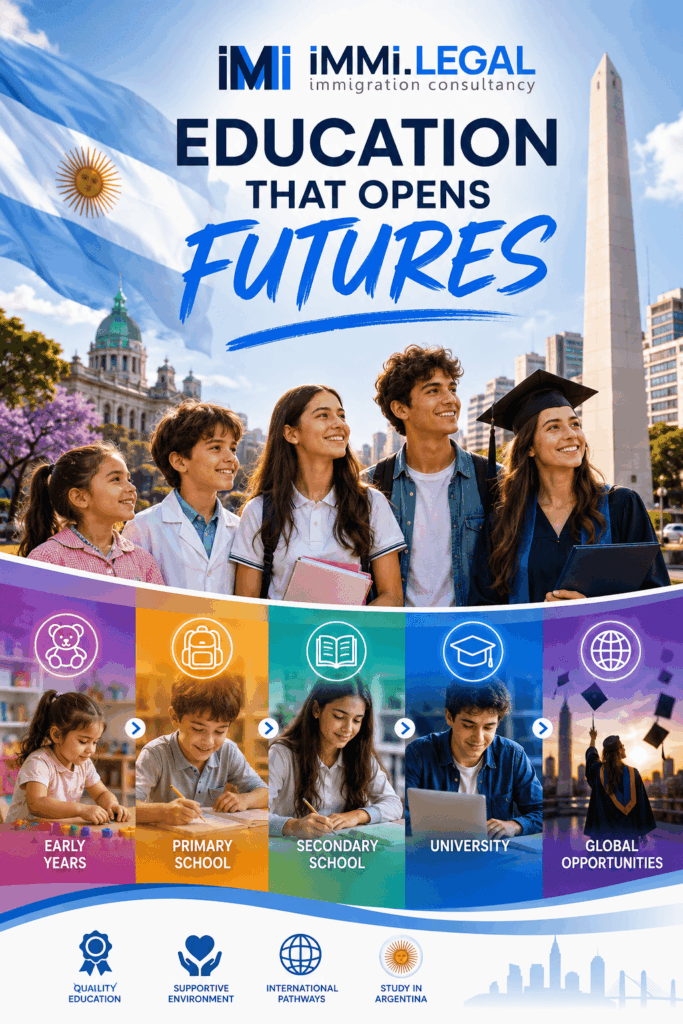
Let’s talk about education in Argentina from kindergarten to university. Public education in Argentina is free for children. Only private academic education is paid.
Maternity leave is relatively short compared to some other countries. Paid leave for child care consists of 45 days before and 45 days after childbirth. However, mothers have the option to reduce their prenatal leave by 15 days and extend their postnatal leave by the same amount. By immigrating to Argentina, you children get access to free and quality education.
Once this period ends, mothers return to work, and their children start attending Jardín Maternal, which is similar to nurseries in other countries. This institution accepts children from 45 days to 3 years old, offering a structured developmental and educational program tailored for each age group.
At the age of 3, children transition to Jardín de Infantes, which serves as preschool until they turn 6. In Argentina, attendance at preschool is mandatory from age 4 to prepare for primary school. This requirement aims to help children adapt to social interactions and group work. Preschools in Argentina use a letter grading system: E (Excelente) for “excellent,” MB (Muy Bueno) for “very good,” B (Bueno) for “good,” A (Aprobado) for “passed,” and NA (No Aprobado) for “not passed.”
Preschools can be either public (free of charge) or private. The fees for private institutions depend on the duration of the child’s attendance (full day vs. half day).
In Palermo, Immi Legal would to recommend an amazing kindergarten: Florence Nightingale Kindergarten. They also have primary and secondary schools in Buenos Aires. We would like to especially highlight the kindergarten, which is located near Alto Palermo and Parque Las Heras. This kindergarten is extremely attentive and caring to its students. The education is bilingual, and all of the teachers speak English, ideal for those who need transition time before learning Spanish. The teachers and the principal of this kindergarten are truly heartfelt professionals with many years of experience.
Pre-collegiate academic Studies in Argentina is divided into two main stages: primary and secondary. Primary education lasts for 6-7 years, while secondary education for 5-6 years. Children typically begin primary school at age 6.
The Argentine school year starts in March and concludes in December. It is divided into three trimesters, with a two-week winter break in July. Grading is generally based on a 10-point scale, where a score of 10 represents the highest achievement. Grades below 7 indicate insufficient understanding of the material. If a student’s final grade for the year is below 7, they must take a comprehensive exam for the entire year’s content. In some regions, a percentage system is used instead, with 100% indicating the highest performance. In others, a categorical system of “E” (excelente), “MB” (muy bueno), “B” (bueno), “A” (aprobado), and “NA” (no aprobado) are used.
Upon completing primary education and passing the necessary tests, students move on to “secundaria,” which spans grades 7-12. This often involves transferring to a different school. Secondary education is divided into two stages: basic (básico), covering a general curriculum from age 13, and advanced (orientado), where students can select courses based on their interests.
If you are interested in private schools, here are some notable institutions with high regard and excellent education:
Belgrano Day School is a highly prestigious bilingual school in Buenos Aires. It offers Cambridge IGCSE/A-level along with IB, as well as an option for a dual U.S. diploma through remote learning. With a history spanning more than a century, this school has taught generations of families—grandparents, parents, and grandchildren—all studying there. There is also an international student body, with many nations represented on campus.
Another school is Colegio Bayard, located in Palermo, not far from the Alto Palermo Shopping Mall. In Palermo Soho, there is a school named Colegio Palermo Chico as well, which are all great options.
In Argentina, schools can be public, private, or subsidized by the government. Private schools range from affordable religious institutions to expensive multilingual ones. Parents sometimes reserve places for their children in desired schools well in advance. Although some public schools collect funds from parents for various needs, these contributions are not compulsory.
1. A tradition for high school graduates is to embark on a trip to a city within Argentina.
2. Instead of traditional notebooks, Argentine students use removable sheets in graph or lined pads that are placed in ring binders.
3. Class sizes in Argentina are typically 25 students per class.
4. Bilingual schools in Argentina often operate in two shifts: one in Spanish and another in a foreign language, e.g., English, German, or French.
Study in Argentina is tiered, including classical universities, institutes with university status, and technical institutes similar to technical schools. Graduates from these institutes receive diplomas and can pursue further studies at universities to complete higher academic education.
Most public universities in Argentina offer affordable education for bachelor’s degrees, including for international students. However, only about 25-30% of students complete their studies within the standard time frame. The system allows for indefinite postponement of exams, and there is no age restriction, leading to extended study periods beyond the typical 4 to 6 years.
Master’s and doctoral programs are considered postgraduate education and have slightly higher tuition fees, averaging around 300 USD monthly.
In summary, Argentina’s educational system offers a structured and engaging pathway from early childhood through higher education. Starting with Jardín Maternal for infants and progressing through a tiered schooling system, children receive a broad foundation of learning and socialization. With mandatory attendance from the age of four and a variety of schooling options, including public, private, and subsidized institutions, the Argentine education system is designed to cater to diverse needs and preferences. The system emphasizes a strong academic curriculum complemented by extracurricular activities and character development. As students advance to secondary and higher education levels, they benefit from a mix of rigorous academic training and practical experiences, preparing them for a range of professional and personal pursuits. Overall, Argentina’s commitment to education reflects a dedication to fostering well-rounded and capable individuals ready to contribute to society.
Immi Legal serves people worldwide on their journey of immigrating to Argentina. Our experienced team and wide range of local collaborations with schools and higher education institutions are committed to creating a solution for your family.
For more information, please visit: https://immi.legal/how-to-immigrate-to-argentina/
References:
Dreamstime. (n.d.). Mature women teacher working in high school tells pupils history of Argentina. Retrieved from https://www.dreamstime.com/mature-women-teacher-working-high-school-tells-pupils-history-argentina-class-holds-national-flag-image315945924
ArgBlueberry. (n.d.). Centros de cuidado infantil: Un servicio a la comunidad que crece en la producción de arándanos argentinos. Retrieved from https://www.argblueberry.com/home/en/centros-de-cuidado-infantil-un-servicio-a-la-comunidad-que-crece-en-la-produccion-de-arandanos-argentinos/
PEPE Network. (2023). Inclusion of autist children in PEPEs in Argentina. Retrieved from https://pepeglobal.org/en/inclusion-of-autist-children-in-pepes-in-argentina/