
Argentina Citizenship by Investment Requirements
- Type: Citizenship
- Country: Argentina
- Duration: 4-6 month
- Status: Awaiting
Economy Minister Luis Caputo and Chief of Staff Diego Santilli, during Argentina Week in Paris, announced the Citizenship by Investment Program to strengthen the investment climate and attract capital. The program is scheduled to become operational and begin accepting applications in the fourth quarter of 2026, creating a new direct route for qualified foreign investors to obtain Argentine citizenship through a qualifying financial contribution or investment.
The program is designed to attract international capital while applying enhanced standards for financial transparency, source-of-funds verification, security screening, and due diligence.
For internationally mobile investors and families, citizenship by investment Argentina represents a potentially significant new option in South America.
Important: The Argentine government has announced the main investment framework and target launch period, but detailed implementing rules and application procedures are still being finalized. Investment amounts, eligibility, documentation, and procedural requirements should therefore be confirmed against the final regulations before an application is submitted.
Argentina Citizenship by Investment: Investment Options
| Criteria | Option 1: Treasury Contribution | Option 2: Public Bond |
|---|---|---|
| Amount | US$350,000 | US$800,000 |
| Investment type | Non-refundable contribution | Argentine Public Bond |
| Purpose | Direct contribution to the Argentine National Treasury | Public bond created specifically for the CBI Program |
| Refundability | Non-refundable | Subject to final bond terms |
| Investment asset | No | Yes — government bond |
| Investment period | Not applicable | Reported 7 years |
| Interest rate | Not applicable | Reported 0% |
| Capital repayment | No | Subject to final redemption terms |
| Transferability | Not applicable | To be confirmed |
| Main advantage | Lower entry amount and simpler structure | Potential return of principal at maturity |
| Suitable for | Applicants prioritizing a lower initial financial commitment | Investors seeking a financial instrument |
According to the announcement, there are going to be two principal investment routes: a US$350,000 non-refundable contribution to the National Treasury or a US$800,000 subscription to a public bond created specifically for the program.
Option 1: US$350,000 Contribution to the Argentine Treasury
The first and currently lowest-cost route is a:
US$350,000 non-refundable contribution to the National Treasury of Argentina.
This is a direct contribution rather than a conventional investment asset. The amount is non-refundable.
For applicants primarily interested in obtaining Argentine citizenship through the most straightforward announced financial route, this is expected to be the principal CBI Argentina option.
Option 2: US$800,000 Argentine Public Bond
The second route involves:
US$800,000 in a public bond created specifically for the Citizenship by Investment Program.
The Government has confirmed the creation of a dedicated public security for the program.
Additional reporting on the program indicates that the planned structure is a seven-year, zero-interest bond. However, applicants should distinguish this reported structure from the information formally confirmed in the initial Government announcement. The final terms governing maturity, redemption, transferability, custody and other conditions should be confirmed once the implementing rules are published.
The bond route may therefore be relevant to investors who prefer an investment instrument over a completely non-refundable contribution.
CBI Argentina Family Options
One of the important features of the announced Argentina citizenship by investment framework is the ability for qualifying family members to apply together with the principal applicant.
The Government has announced the following additional contribution amounts:
Family Member | Announced Contribution |
Spouse | US$100,000 |
Child aged 18-25, unmarried and without children | US$100,000 |
Child under 18 | US$25,000 |
Family members must demonstrate the relevant family relationship and satisfy the applicable requirements.
Example: Family of Four
The Argentine Government has specifically provided an example consisting of:
- Principal applicant
- Spouse
- Two children under 18
Under the US$350,000 contribution route, the announced total would be:
USD 350,000 + USD 100,000 + USD 25,000 + USD 25,000 = USD 500,000
Therefore, a family of four consisting of one principal applicant, a spouse and two minor children could potentially pursue Argentine citizenship through the announced contribution route for a total of US$500,000, excluding applicable professional, governmental, documentary and other expenses.
Under the bond route, the principal applicant would subscribe to the announced US$800,000 bond, while eligible family members would make their applicable Treasury contributions. The precise treatment of family members under the final operational rules should be confirmed before filing.
For a full overview of Argentina’s CBI requirements, investment routes, and how to prepare before the program opens: READ GUIDE →
One-Time In-Country Biometrics Visit Requirement
One in-country visit to Argentina is expected at the approval stage—for biometrics and final formalities only. No prior or subsequent presence is required. Processing timing is subject to final program rules.
Does CBI Argentina Require Two Years of Residence?
One of the most important reasons international investors are watching citizenship by investment Argentina is the distinction between the new investment route and traditional naturalization.
The announced CBI framework is designed to provide a citizenship route without requiring the applicant to first complete the usual two-year residence period.
This is a fundamentally different proposition from obtaining Argentine permanent or temporary residence and subsequently pursuing naturalization under the ordinary framework.
However, the final regulations will determine the precise legal and procedural requirements for CBI applicants, including the application process, approval mechanism, documentation, and any physical-presence requirements.
Applicants should therefore not assume that rules applicable to ordinary naturalization automatically apply to CBI Argentina applications.
How the Argentina CBI Application Process Is Expected to Work
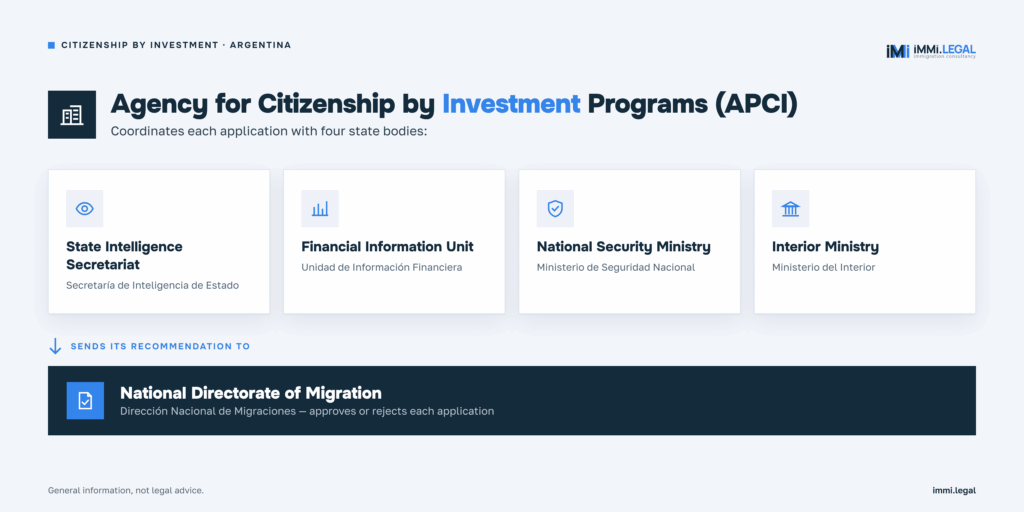
The Government has indicated that the program will operate through a dedicated institutional framework involving the Agency for Citizenship by Investment Programs (APCI).
The announced assessment process is intended to be rigorous and includes several layers of due diligence.
The Government has stated that applications may be reviewed for:
- Identity verification
- Source and traceability of investment funds
- Lawful origin of wealth
- Financial and asset information
- Jurisdictional risk
- Criminal background
- Reputational risk
- Immigration history
- Financial transparency
- Anti-money-laundering compliance
- Counter-terrorist-financing considerations
The process is expected to involve several Argentine government bodies, including APCI, the Financial Information Unit (UIF), the Ministry of Security, the Ministry of the Interior and the State Intelligence Secretariat.
Following the assessment, APCI will make a recommendation to the National Directorate of Migration, which will have the authority to approve or reject the application.
This means that meeting the financial threshold alone does not guarantee citizenship, which applicants must keep in mind.
Source of Funds and Source of Wealth for CBI Argentina
For prospective applicants, one of the most important parts of preparation will be demonstrating the legitimate origin of the investment capital.
Applicants should expect comprehensive source-of-funds (SOF) and source-of-wealth (SOW) due diligence.
Depending on the applicant’s circumstances, supporting documentation may include:
- Bank statements
- Employment records
- Payslips
- Business ownership documents
- Corporate records
- Investment records
- Property ownership documents
- Property sale agreements
- Evidence of investment income
- Dividend records
- Tax and financial documentation
- Wealth declarations
- Evidence explaining the accumulation of the applicant’s assets
The objective is not simply to demonstrate that the applicant has sufficient funds.
The applicant should also be able to explain where the money came from and how the applicant accumulated their wealth.
This is particularly important for entrepreneurs, business owners, investors, cryptocurrency holders, individuals with complex international banking structures, and applicants whose wealth comes from multiple jurisdictions.
Background Checks and Due Diligence
The Argentine government has stated that the program will apply standards aligned with international recommendations from the OECD and FATF.
This means that CBI Argentina should not be limited to PEP and global sanctions screening (OFAC, UN, EU) and an adverse media check.
A comprehensive application may involve:
- Criminal record certificates
- Police clearance certificates
- International background checks
- Sanctions screening
- PEP screening
- Adverse media checks
- Immigration-history review
- Financial due diligence
- Source-of-funds verification
- Source-of-wealth verification
Applicants and family members should therefore begin collecting historical documentation well before the program formally opens.
Documents for Argentina Citizenship by Investment
Although the final official application checklist remains subject to the implementing regulations, advance preparation can significantly reduce delays.
Typical documents expected to be relevant include:
Identity and Civil Status
- Valid passport
- National identity documents
- Birth certificate
- Marriage certificate, where applicable
- Divorce documents, where applicable
- Death certificate of a former spouse, where applicable
- Name-change documentation, where applicable
- Proof of residential address
Criminal and Background Documentation
For the principal applicant and relevant family members:
- Police clearance certificates
- Criminal record certificates
- Certificates from countries of residence
- International background screening
- PEP and sanctions screening, where applicable
Source of Wealth and Source of Funds
- Bank statements
- Employment documentation
- Business ownership records
- Corporate documents
- Property ownership records
- Property sale agreements
- Investment statements
- Dividend or income evidence
- Wealth declarations
- Documents explaining the origin of the investment capital
Foreign documents will generally need to be apostilled or legalized, as applicable, and translated into Spanish by an Argentine-certified sworn translator where required.
Because documentation requirements may differ depending on nationality, country of residence, family structure and source of wealth, each applicant should receive an individualized document assessment before filing.
Why Prepare for CBI Argentina Before Applications Open?
Because the program is approaching its operational stage, this is the appropriate time for prospective applicants to review their documentation, source of wealth, source of funds, and family records rather than waiting until applications open.
IMMI Legal can assist with the preparation and coordination stage so that prospective applicants are positioned to proceed once the final CBI Argentina rules and application procedures are published.
Final Note on the Argentina CBI Program
Argentina’s Citizenship by Investment Program is one of the most significant new developments in the country’s immigration and investment landscape.
At present, the most important distinction is between what has been officially announced and what is still awaiting detailed implementation.
The USD 350,000 contribution, USD 800,000 bond route, family contribution levels, and Q4 2026 launch timeframe have been publicly announced by the Argentine Government. Detailed operational rules should be verified before any applicant commits capital or submits documentation.
For investors considering CBI Argentina, early preparation can provide a significant practical advantage: complex financial, corporate, and civil-status documentation can be reviewed and organized before the application system becomes fully operational.
Frequently Asked Questions About CBI Argentina
Not yet. The government has announced it and aims to launch in the fourth quarter of 2026. They’re still finalising the full set of rules and application procedures, so you can’t submit an application at the moment.
It’s expected to start accepting applications in Q4 2026. This was confirmed by Economy Minister Luis Caputo and Chief of Staff Diego Santilli during Argentina Week in Paris.
The detailed rules—exact application steps, document checklists, and final fees—are still being worked out by the Agency for Citizenship by Investment Programs (APCI).
The exact date will be known once the final regulations are published in the official gazette (Boletín Oficial).
Two main options have been announced:
- Treasury contribution: US$350,000 (non-refundable) paid directly to the Argentine National Treasury.
- Public bond: US$800,000 invested in a special public bond created for this program.
On top of the main amount, you’ll need to budget for additional contributions for family members, plus professional fees, due diligence costs, translations, apostilles, and government charges.
No. It’s a one-time, non-refundable contribution to the Treasury—it’s more like a donation than an investment you get back.
This involves subscribing to a public bond designed specifically for the program. Early indications suggest it could be a seven-year, zero-interest bond with the principal returned at maturity. Final details (maturity, redemption rules, transferability, etc.) will only be confirmed when the implementing regulations are published.
Most applicants expected to prefer Option 1: the USD 350,000 non-refundable contribution, mainly because they do not want to lock up USD 800,000 for seven years. A lot can change during that time.
Option 2 may be attractive if you are comfortable waiting seven years and like the possibility of recovering the USD 800,000.
Ultimately, it depends on your priorities. If flexibility and control over your capital are more important, Option 1 may be the better fit. If you prefer the possibility of getting the full amount back later, Option 2 may be worth considering. Whatever you choose, the best choice depends on your personal finances, risk tolerance, and goals.
Yes. Qualifying family members can be included in the same application. You’ll need to prove the family relationship and meet the relevant requirements.
In short, it’s preferable to include your wife and children in the same application from the beginning.
The final program rules have not been published yet, so we cannot confirm exactly. However, applying together generally helps avoid extra steps, delays, or potential additional costs later.
Once the final regulations are released, we will know for certain whether family members can be added after approval and under what conditions. Until then, the safest approach is to plan the application as a family from the start.
Based on what’s been announced so far (still subject to final confirmation):
- Spouse: US$100,000
- Unmarried child aged 18–25 with no children of their own: US$100,000
- Child under 18: US$25,000